
 Sign In














 Email Marketing

 ABM
 List Building
 Lead Generation
 Growth Hacker
 Digital Marketing
 Data Enrichment
 Software as a Service
 Data as a Service
 Waterfall Enrichment
 Startup
 Revenue Performance
 Job Change Tracking
 Customer Data Platform
 CRM



 Knowledge Base
 Video Tutorials
 Help Center
 Tarpitting Scoring
 ROI Calculator
 About us
 Contact us
 Testimonials
 Catch-all Email Validation
Email Validation for Developers
Stop fake, mistyped and disposable emails at the source, with one API
Developers use the Gamalogic email validation API to keep bad addresses out of their applications. Check each email at signup in about a second, clean the data you already have with bulk jobs, and get results back by webhook, from any language that can make an HTTPS request.

What developers need from an email check
Four things decide whether validation helps your product or becomes another dependency to babysit.
Scales with your traffic
Validation should keep up with signup spikes, imports and batch jobs without becoming the slow step in your request path.
Fast enough for a form
A user waiting on a signup form needs an answer in about a second. Anything slower belongs in a background job.
Async results for big jobs
Large files should run in the background and report back by webhook, so your app never polls or blocks.
Limits you can plan around
Know your account's burst limit and ask for a temporary increase before a launch or a big migration.
Where weak email checks fail engineering teams
These problems rarely show up in a demo. They show up in production.

Slow responses
A slow check on a signup form adds friction at the exact moment a user decides whether to stay.
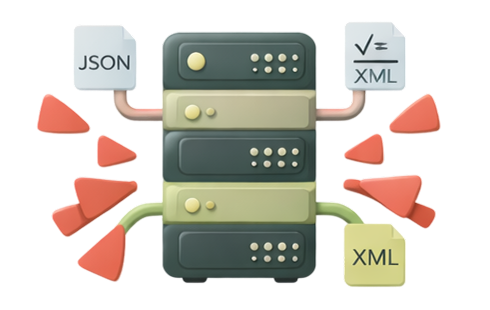
Poor scalability
Validators that throttle under load force you to build queues and retries around someone else's bottleneck.
False “valid” results
Basic checks pass catch-all domains and gateway-protected mailboxes, so bad addresses still reach your database.

No one to ask
When an integration misbehaves at 2 a.m., documentation alone doesn't fix a production incident.
How Gamalogic solves each problem
Gamalogic gives developers one email validation API for real-time checks at signup and bulk validation for everything already in the database, with the deeper checks basic tools skip.

Slow responses
SolutionThe real-time API returns most results in about a second, with a bounded timeout so your form never hangs.

Poor scalability
SolutionBulk validation runs large files in the background and reports back through Webhook & Sync.

False “valid” results
SolutionCatch-all detection and SEG validation check the mailboxes basic tools mark as valid.

No one to ask
Solution24×7 live chat and tickets from people who know the API, plus higher rate limits before a launch. Contact support.
Four ways to wire email validation into your stack
Most teams use two of these: a server-side check at signup, and a batch job for everything already in the database.
| Pattern | Use | Best for | Where the API key lives |
|---|---|---|---|
| Website widget | JS widget | Marketing sites and landing pages where you can't change the back end | In the widget setup; no server code needed |
| Server-side check at signup | Real-time API or the npm package | Account creation, checkout and any form that writes to your database | Server only, in an environment variable |
| Batch with webhook | Webhook & Sync | CSV imports, CRM migrations and nightly re-checks | Server only; your webhook endpoint should verify each call |
| No-code automation | Make, Google Sheets | Ops and growth teams wiring tools together without engineering time | Stored in the automation tool's connection |
What your code should do with each result
Blocking every non-valid address loses real users. Map each result to an action instead.
| Result | What it means | Recommended action |
|---|---|---|
| Valid | Mailbox exists and passed every risk check | Accept |
| Invalid | Bad syntax, dead domain or no such mailbox | Block and ask the user to check for typos |
| Disposable | Temporary inbox (learn more) | Block at signup, or allow with limits, per your policy |
| Role-based | Shared inbox such as info@ (learn more) | Accept, flag for sales and onboarding |
| Catch-all | Domain accepts every address (learn more) | Accept, use the risk score to decide |
| Unknown | Server gave no clear answer (greylisting, tarpitting, timeout) | Accept, then re-check in bulk within 24 hours |
Production checklist
Validation sits in your signup path, so treat it like any other external dependency: keep secrets on the server, bound the wait, and never let a slow answer block a real user.
For what happens inside a single request, from the syntax check to catch-all detection, see the real-time email validation API page.
- Call the API from your server and keep the key in an environment variable, never in client code
- Set a short timeout on the call and fail open: accept the signup and queue the address for a re-check
- Treat “unknown” as a soft result, not an error
- Store the status and reason codes with each user record for support and analytics
- Run big imports as a batch job with a webhook, not as a loop of single calls
- Know your burst limit and request a temporary increase before launches
- Watch status.gamalogic.com and alert on repeated failures
Ways to add email validation to your product
Pick the integration path that fits your stack, from one API call to a no-code widget.

Bulk list cleaning
Validate large files in batch and receive results by webhook.
Bulk email validation

24×7 help from people who know the API
Live chat and tickets around the clock, plus the help center and video tutorials.
Use cases developers read next
Software as a Service
Stop fake signups and free-trial abuse at the form.
Read use caseTransactional Email
Make sure receipts, password resets and alerts reach a real inbox.
Read use caseData as a Service
Ship verified contact data your customers can rely on.
Read use caseCustomer Data Platforms
Validate emails as customer profiles are merged and unified.
Read use caseCRM Systems
Keep CRM records valid as contact data ages.
Read use caseStartups
Protect sender reputation from day one, on a startup budget.
Read use caseDeveloper questions about email validation
Which programming languages can I use with Gamalogic?
Any language that can send an HTTPS request and read JSON, including JavaScript and Node.js, Python, PHP, Java, Ruby and Go. Node.js developers can also use the npm package.
Should I validate emails on the client or the server?
Use the server for anything that decides whether an account is created, so the check can’t be skipped and your key stays private. Add the JS widget on the client if you also want users to see typos before they submit.
What should my code do with an unknown result?
Accept the address, store the result, and re-check it in bulk within 24 hours. Unknown usually means the mail server delayed its answer, not that the address is bad.
How do I keep my API key safe?
Keep it in an environment variable on your server and call Gamalogic from your back end. Never put the key in front-end code, a mobile app bundle or a public repository.
How do I validate a large import without slowing my app?
Send the file as a batch job and let Webhook & Sync notify your app when results are ready. Your request threads stay free while the job runs.
What happens if the validation call is slow or fails?
Set a short timeout and fail open: let the user continue, then queue the address for a later re-check. You can follow service health at status.gamalogic.com.
Ship email validation this sprint
Create an account, copy your API key and make your first call in minutes. You get 500 free credits, with no credit card.